
Updates on FCR prices
FCR prices in the common European market

Frequency Containment Reserves (FCR) are one of the fundamental components of balancing markets in Europe. To avoid repeating the basic principles in this post, here are some sources on FCR:
From ENTSOE.
From a former post.
From next-kraftwerke.
In this post, I will focus on recent developments in the FCR market across the nine countries that participate in the common market. It’s worth noting that, with a demand of 1,700 MW in 2026 for these countries and an assumed average price of €60 per MW per four-hour block, the annual market size is estimated to be around €220 million.
The demand
Let’s start by looking at demand. Each country has a specific FCR requirement—the total quantity that must be fulfilled. Below, you’ll find the projected demand for 2026. The demand remains relatively consistent across the different blocks, each representing a four-hour segment of the day.
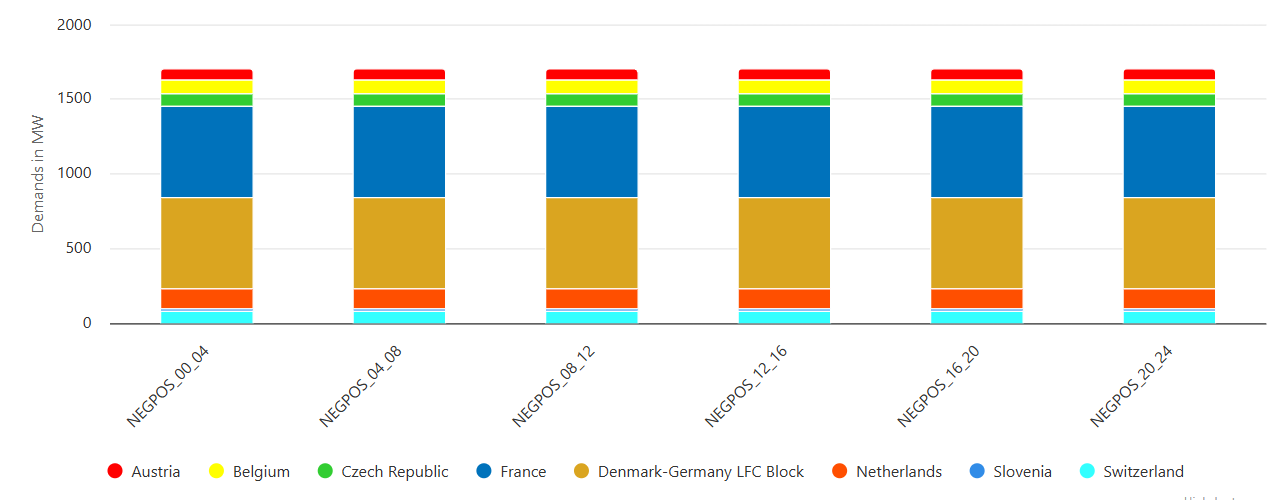
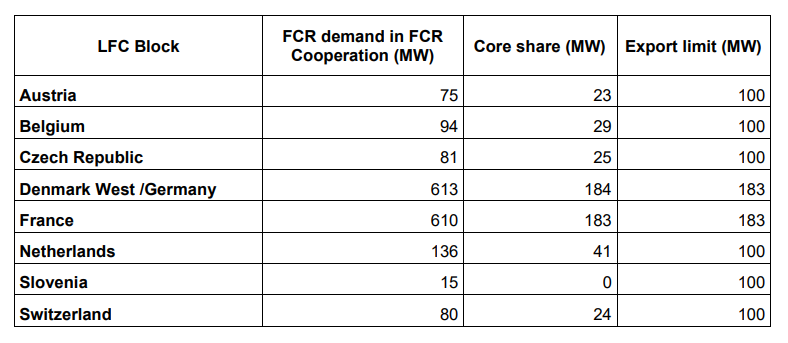
In the table below, the first column shows each country’s FCR demand, alongside the core share—the minimum volume that must be covered by local bids—and the export limits, which indicate the maximum portion of local bids that can be exported to other countries. As you can see, France and Germany are the major players in the FCR market, together accounting for more than 70% of the total demand.
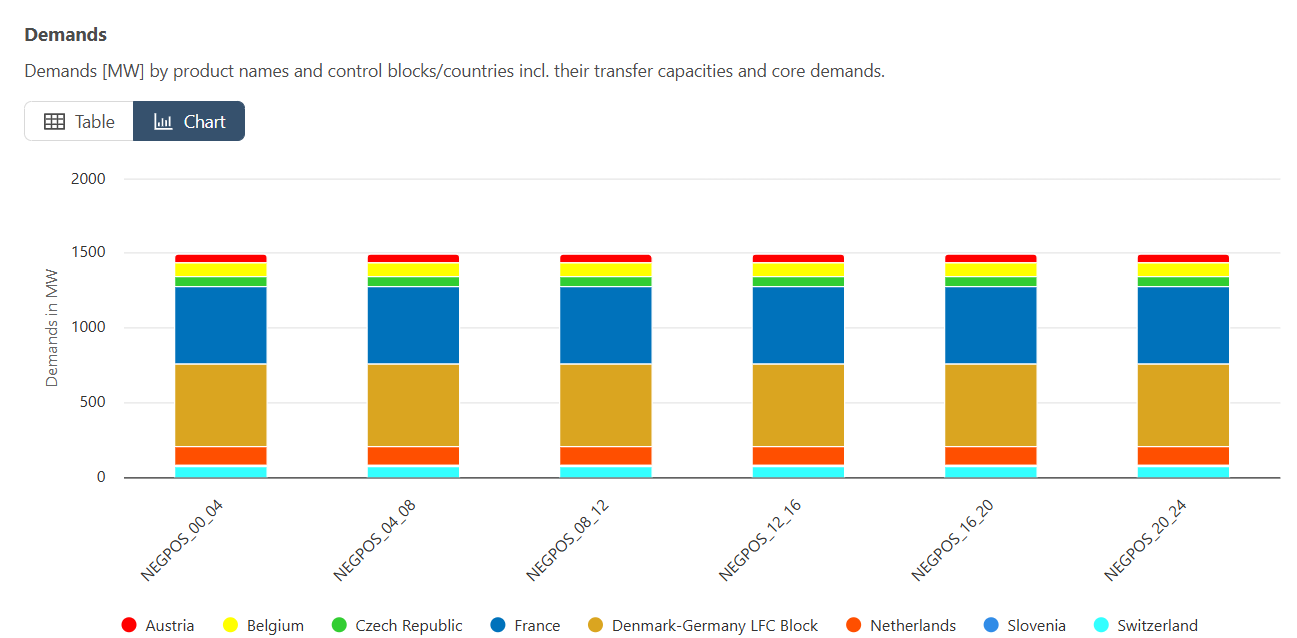
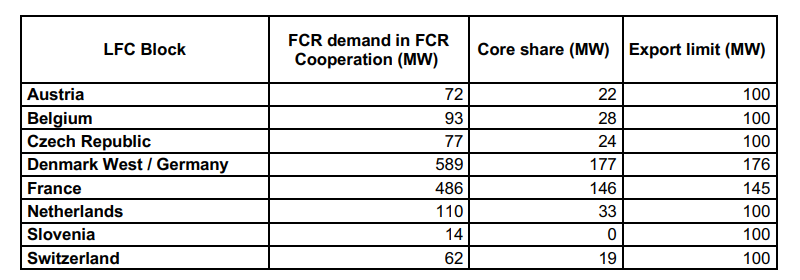
For reference, the figures below present the same information for 2025. Both the overall demand and its distribution have increased from 2025 to 2026. Notably, France’s demand rose from 486 MW in 2025 to 610 MW in 2026. Additionally, the export limit increased from 145 MW to 183 MW, meaning that up to 793 MW of local French bids could potentially be procured in 2026, compared to only 631 MW in 2025.
General overview of the results
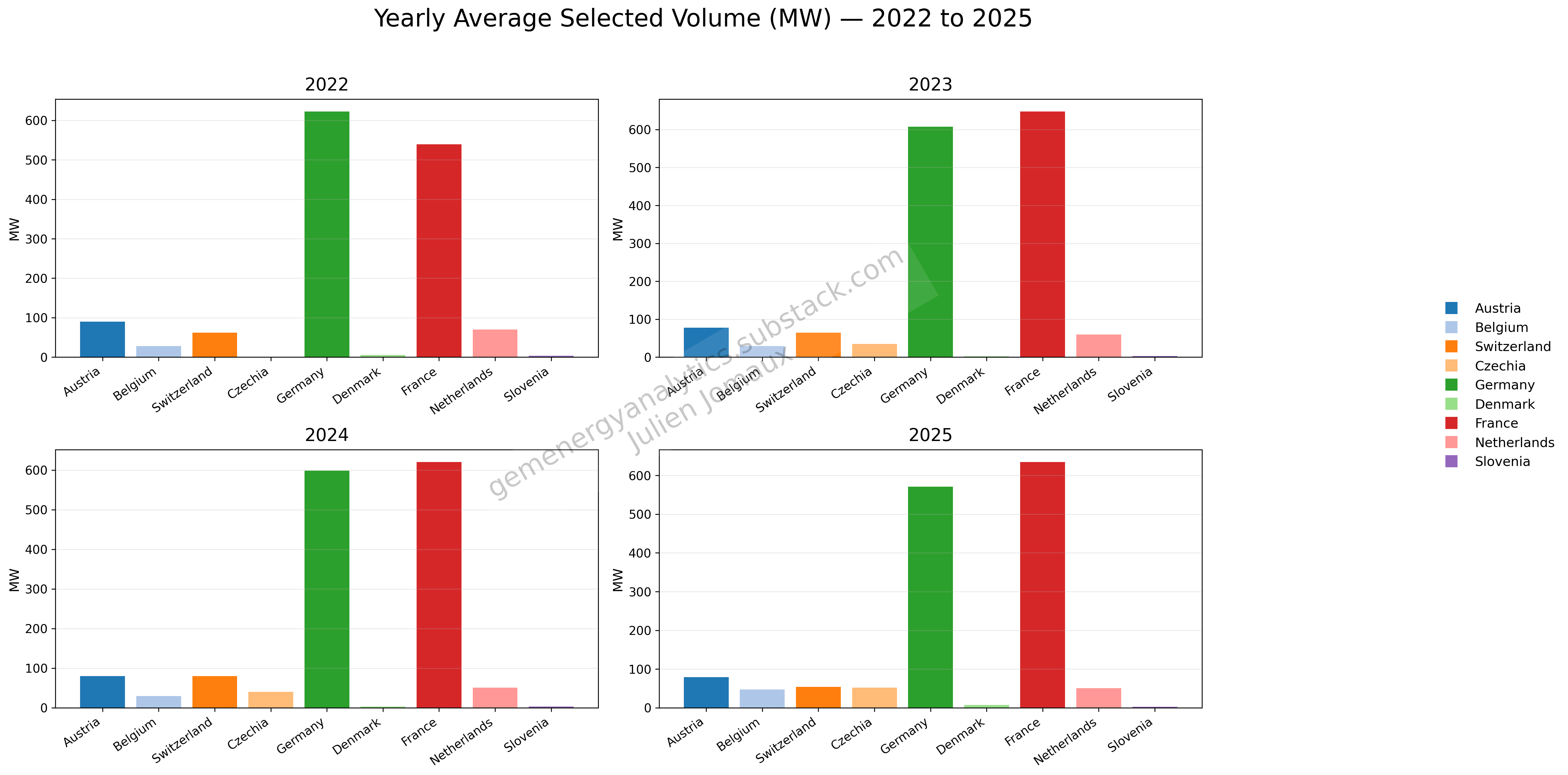
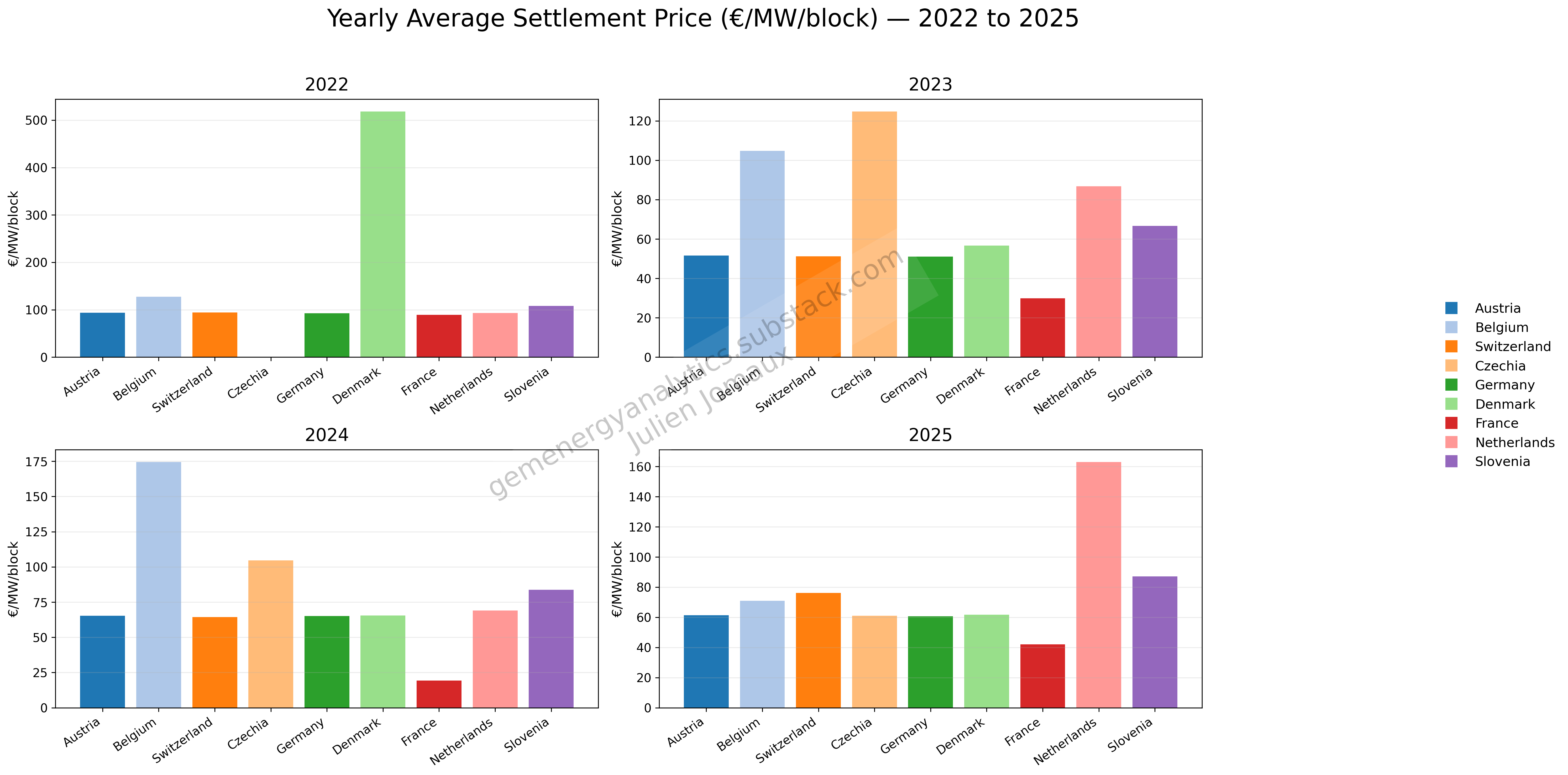
Looking at the overall results, we observe the following trends. The first graph presents the average yearly volumes selected locally, while the second graph shows the average prices. Notably, France has seen an increase in selected volumes from 2022 to 2025, whereas Germany’s volumes have decreased during the same period.
In terms of prices, France has experienced lower FCR prices over the past three years, particularly in 2024. In contrast, Belgium saw elevated prices in both 2023 and 2024, while the Netherlands experienced high prices in 2023 and again in 2025. For the Netherlands, it’s worth noting that the average was influenced by a few instances of exceptionally high prices, which will be discussed later in this post.
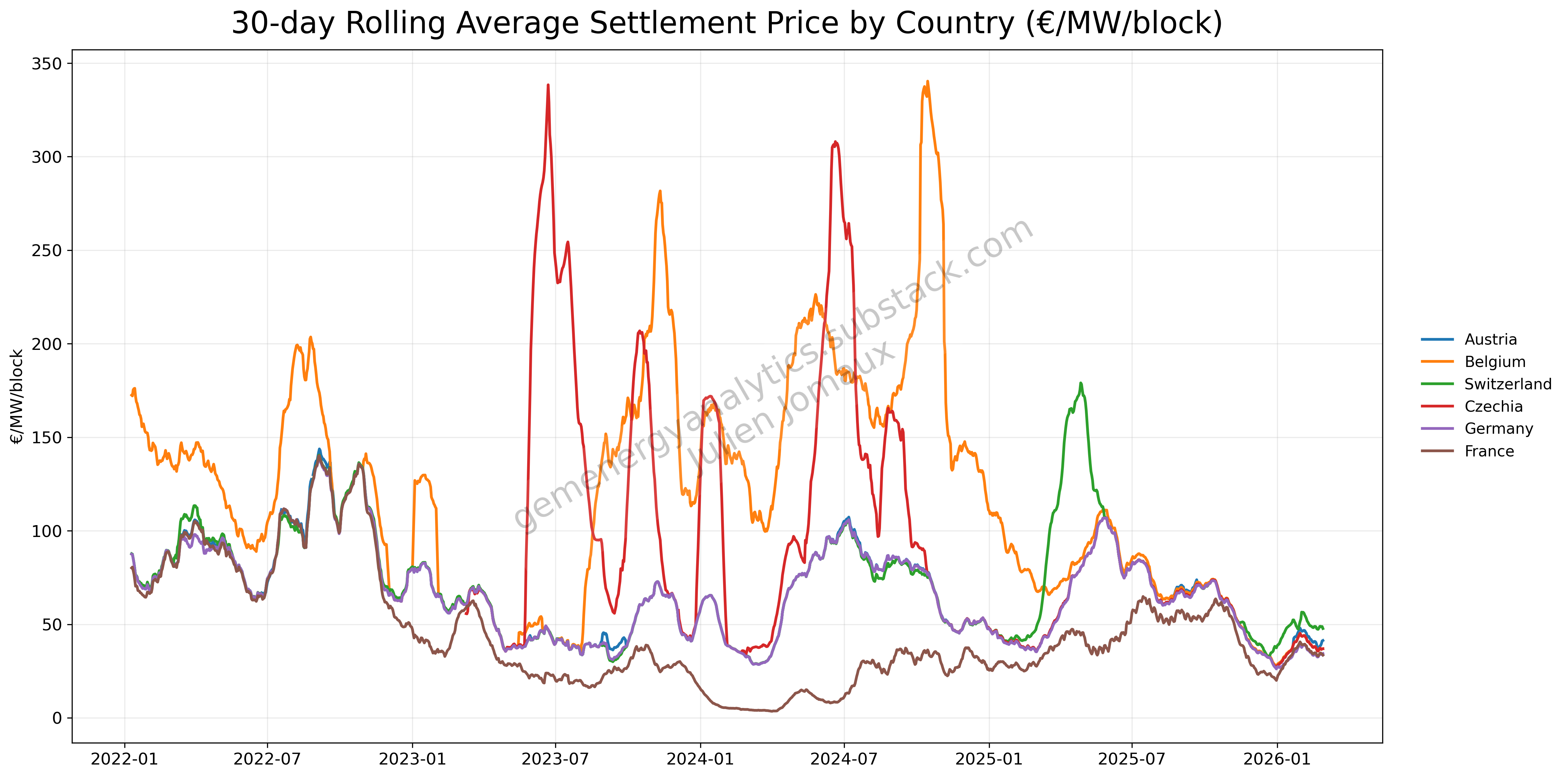
Below is the rolling average for the selected countries (the Netherlands has been excluded due to a few extreme price spikes, as well as Denmark and Slovenia, given their low demand). The data shows periods where prices converge across countries and others where significant differences persist, particularly for Czechia and Belgium. Additionally, it is clear that France has consistently maintained lower prices over a relatively long period.
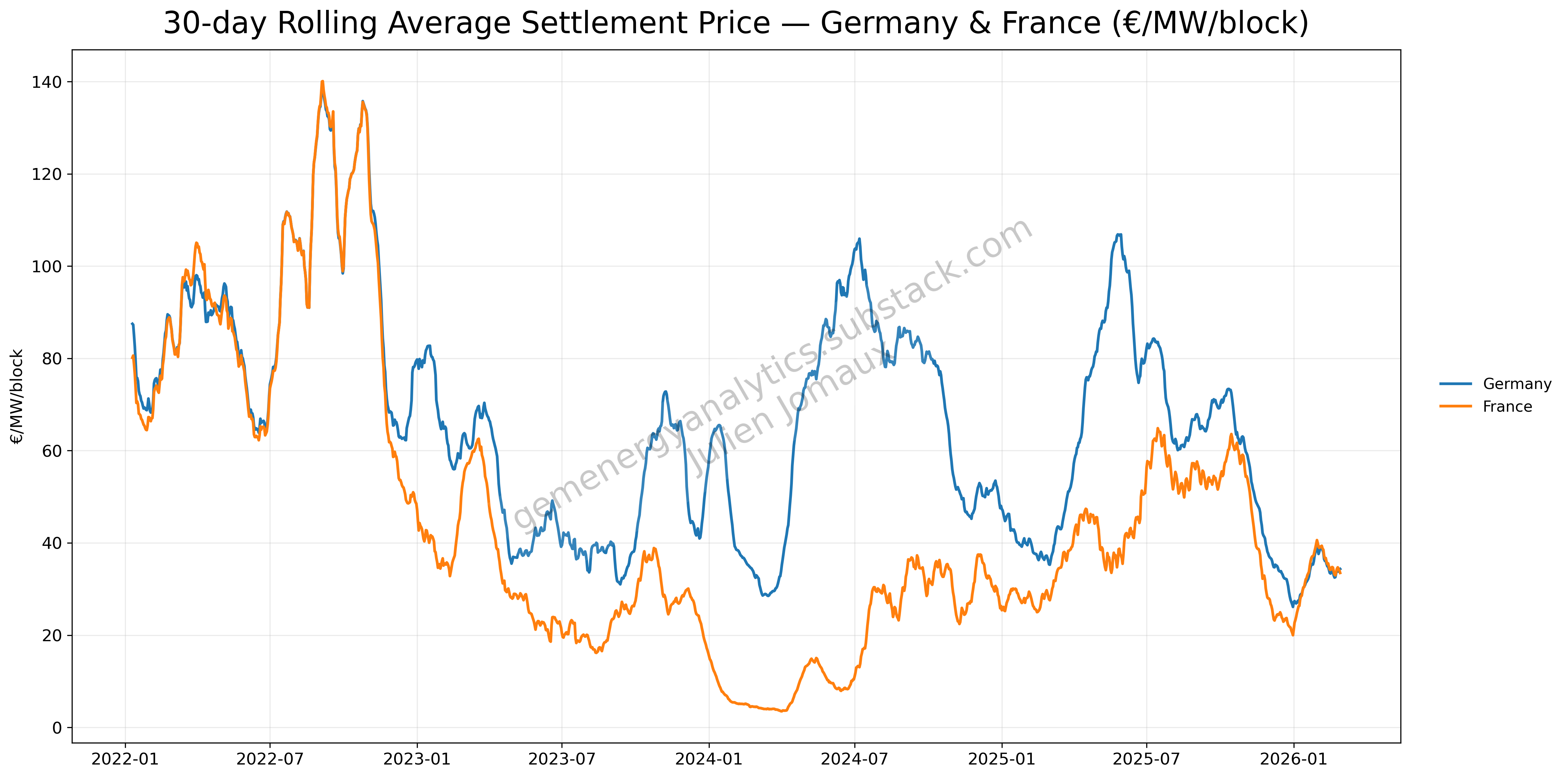
Focusing on France and Germany, we can clearly observe that prices often converged in 2022, but began to diverge significantly from 2023 through the end of 2025. In 2026, prices appear to be converging again, likely due to the increased demand in France and higher export limits, which allow more French local bids to be selected. Other contributing factors may include changes in neighboring countries, which will be discussed further in the following sections.
After the paywall, I’ll provide a more detailed analysis of prices and selected volumes for each country—Germany, France, Belgium, Switzerland, and the Netherlands. Additionally, I’ll showcase examples of the merit order on specific days, highlighting instances of inelasticity that occasionally occur in the FCR market.