
PICASSO: insights and data
An introduction to PICASSO, the European platform for exchanging aFRR energy bids.

Ancillary services are essential for maintaining a stable electricity grid. In Europe, a variety of products exist with different characteristics—one of them is aFRR, or automatic Frequency Restoration Reserve. In previous posts, I have explored several aspects of European balancing, including an introduction to aFRR, the German aFRR capacity markets, and the dynamics of balancing markets during periods of grid stress (such as “Dunkelflaute” and “Hitzeflaute”). In this post, I will discuss a relatively recent development: the exchange of aFRR balancing energy between European countries, facilitated by the PICASSO platform (Platform for the International Coordination of Automated Frequency Restoration and Stable System Operation).
A short history
Transmission System Operators use aFRR to automatically restore grid frequency to 50 Hz and relieve primary control reserves (FCR). Since deviations can occur in different directions across countries, and rather than activating upward reserves in one country and downward reserves in another simultaneously, European grid operators introduced a process called IGCC (International Grid Control Cooperation), which performs imbalance netting across borders. This approach allows opposing imbalances to be offset, reducing the need for unnecessary activations. Imbalance netting through IGCC has been implemented successfully over the past decade.
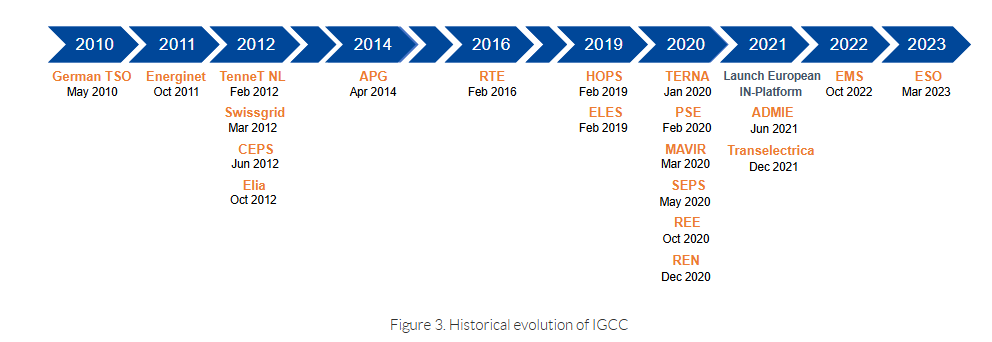
Nevertheless, imbalance netting has its limitations: each TSO must still rely solely on their own resources to meet the netted demand. This is where PICASSO comes in. With the introduction of PICASSO, TSOs across Europe can now exchange aFRR energy. In practice, this means that the lowest-cost aFRR energy bids can be activated across borders, provided that interconnection capacities permit it. By enabling the exchange of aFRR energy, PICASSO allows TSOs to balance the grid more cost-effectively, ultimately reducing the overall cost of system balancing.
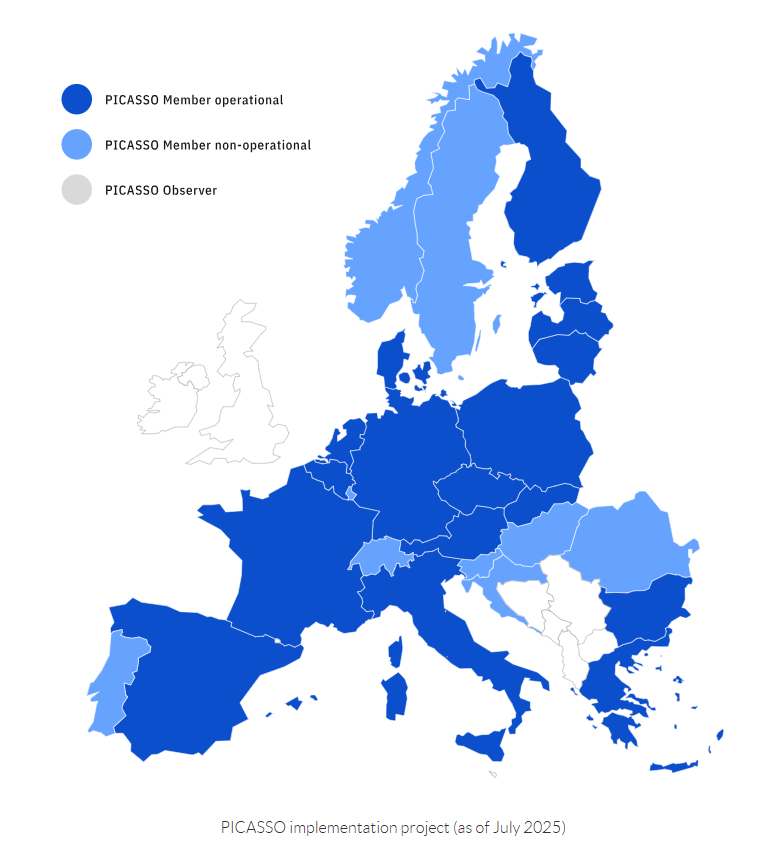
In a way, PICASSO can be seen as the extension of the energy market integration (market coupling of day-ahead and intraday markets) to the energy balancing markets. Interestingly, the twin project of PICASSO, called MARI1, exists also for the other balancing reserve, the mFRR, or manual Frequency Restoration Reserves2.
Why do TSOs exchange aFRR energy bids?
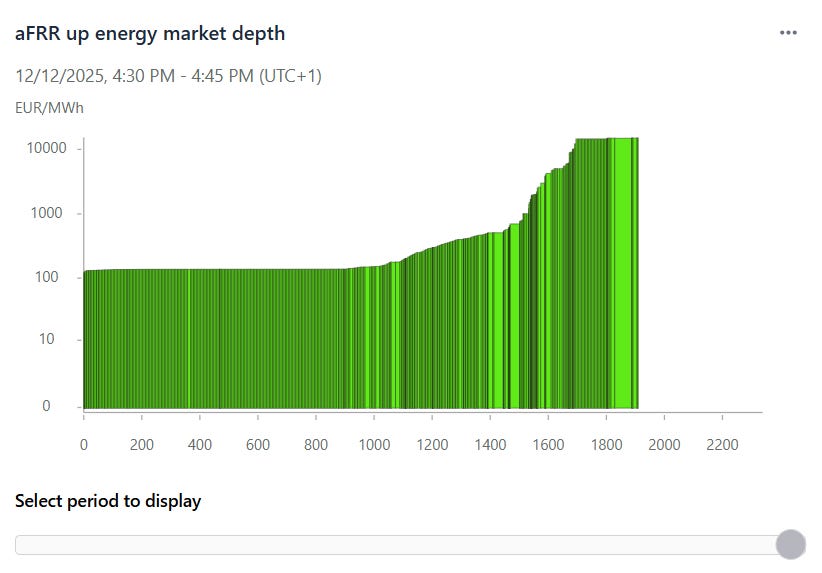
One could wonder why it actually matters to exchange aFRR energy bids. Actually, it is simply because the available aFRR bids per country can be very different. Let’s take a quick look at two quite different aFRR energy bids: the Czech Republic and Germany3 .
Let’s start with Germany. As shown in the chart, there are energy bids totaling up to 1 GW clustered at very similar price levels, with the overall volume reaching up to 2 GW across the entire price range (extending to 15,000 €/MWh). Please note that the y-axis uses a logarithmic scale.
Below is the aFRR energy market in the Czech Republic. During this quarter-hour period, activating just 100 MW results in a price of 500 €/MWh, while activating more than 190 MW leads to market saturation and a steep increase to 14,000 €/MWh. In this scenario, it’s clear that importing aFRR energy bids from Germany would have provided significant benefits.
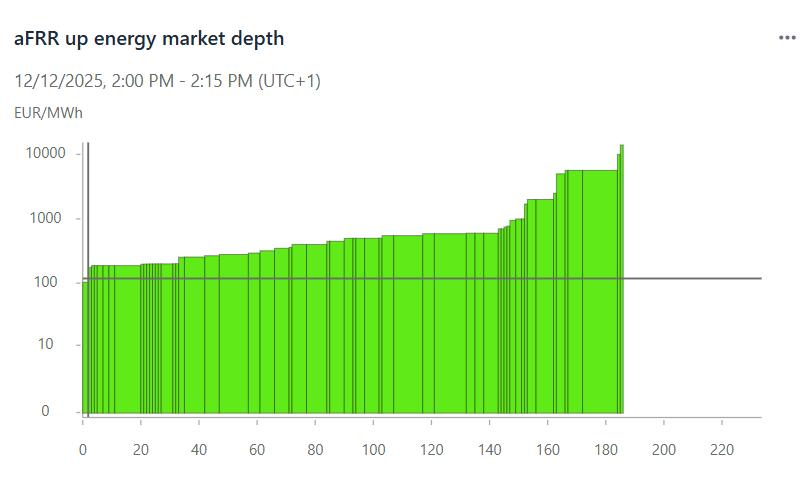
In practice, this means that as long as there is sufficient cross-border capacity to exchange aFRR energy, prices between countries remain aligned. However, when cross-border capacity is limited, price differences can occur—sometimes dramatically, as seen in the Czech Republic, where only this country’s CBMP reached such an extreme level on 1 January 2026. This situation also had a significant impact on the imbalance price, which surged to 62,229 CZK/MWh (2,573 €/MWh).
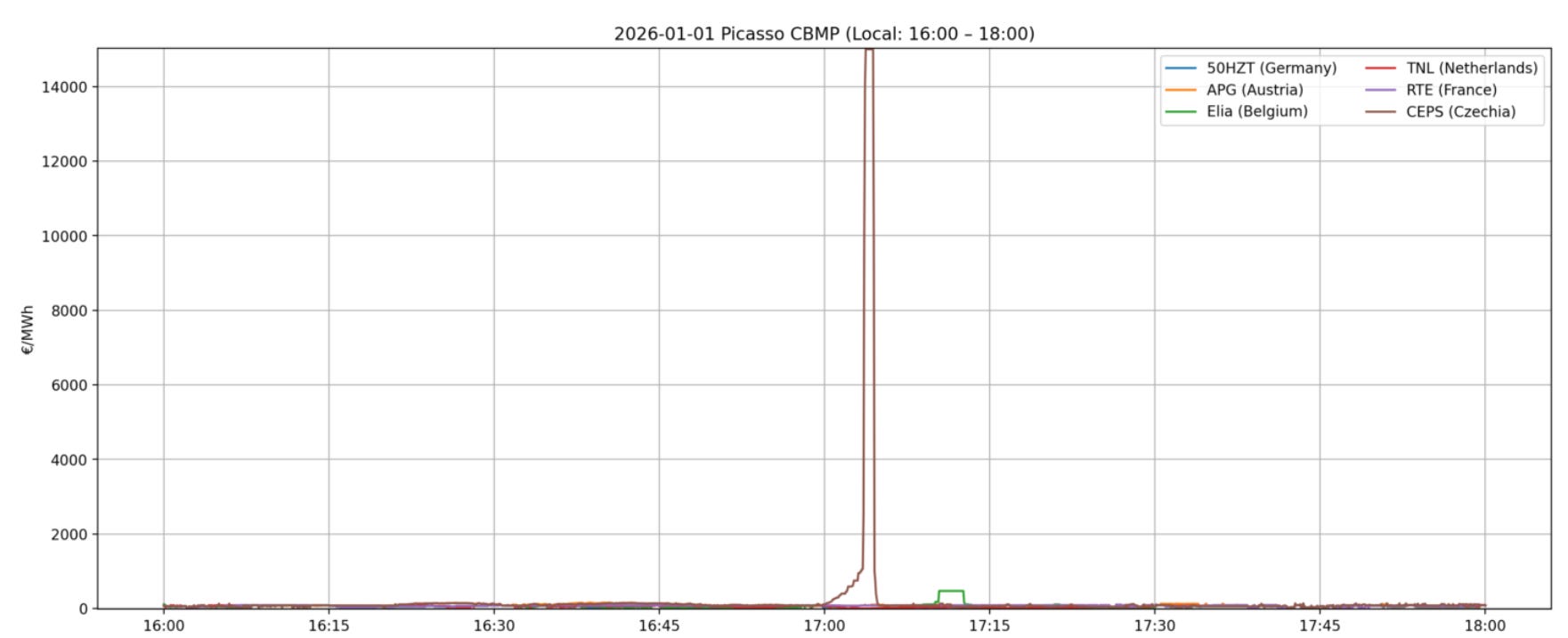
aFRR activation prices and the impact on imbalance price
As illustrated in the previous example, the introduction of PICASSO is advantageous for most countries, particularly for those with a limited merit order size, as their merit orders are often smaller and therefore subject to large variation of prices.
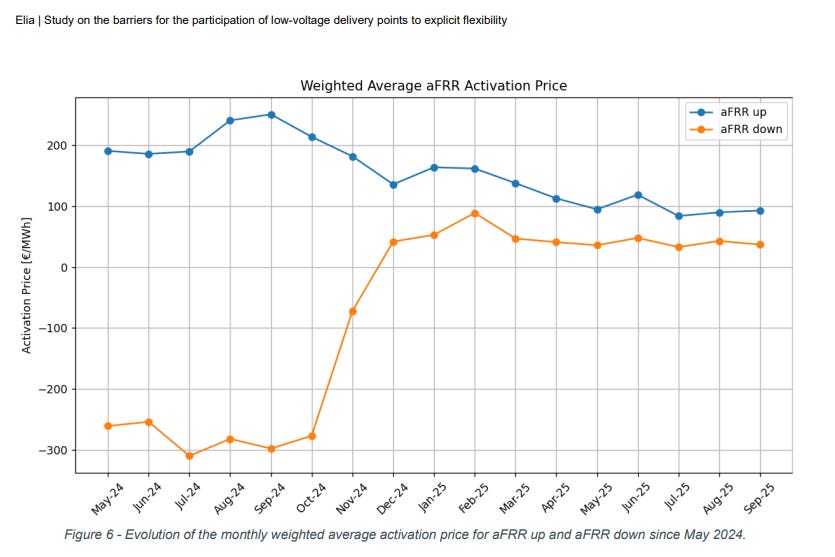
Let’s look at the case of Belgium, which joined the platform in November 2024. The chart below shows the weighted average aFRR activation price per month. Prior to connecting to PICASSO, the price difference between upward and downward directions regularly exceeded 400 €/MWh—a result of depending solely on local aFRR energy bids. Since Belgium’s integration into PICASSO, this price gap has narrowed significantly, falling to below 100 €/MWh.
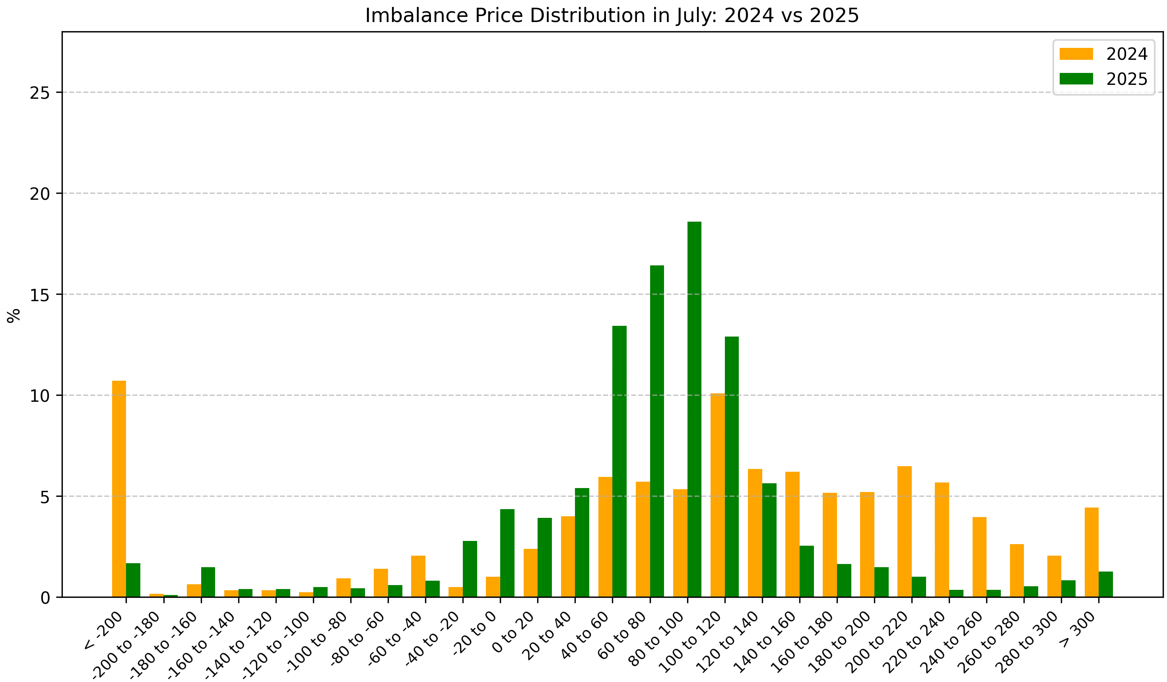
This reduction in aFRR activation price differences has also impacted the distribution of imbalance prices, resulting in less extreme spread. This trend is clearly illustrated by the histograms below, which compare the imbalance price distributions in Belgium for July 2024 and July 2025.4.
Data App to visualize prices
To help visualize the price data, I developed a simple app that displays prices for each bidding zone, updated every four seconds. These prices are referred to as CBMP, or Cross-Border Marginal Price.
aFRR activation prices (CBMP - PICASSO)
In the following sections, available under the paywall, I’ll go deeper into PICASSO by examining specific examples, discussing the degree of similarity between countries, and exploring how batteries could serve as a harmonizer across different countries.
